Early Years
Welcome to Our Early Years’ Curriculum
At our school, we place the highest importance on the Early Years. As a school without a pre-school, we take our responsibility for children’s early learning and their transition into primary school incredibly seriously. We recognise that the foundations laid in these formative years are vital for future success and we are committed to giving every child the very best start to their school journey.
We strongly believe that children learn best through a careful balance of play and direct instruction. Our Early Years’ environment is thoughtfully planned to provide rich, meaningful play opportunities alongside purposeful adult-led learning. Skilled adults support, challenge and extend children’s thinking knowing when to step in to teach new skills, model language or deepen understanding and when to step back to allow children to explore independently.
Our curriculum is carefully designed and tailored to meet the needs of our unique cohorts. What children learn in the Early Years builds securely into Year 1 and beyond - ensuring clear progression and continuity across the school. Subject leaders have a strong understanding of where learning begins in the Early Years and how it develops over time - enabling them to plan with confidence and ambition.
In our Early Years classrooms, you will find learning built on a bed of love, laughter and care. We understand that for children to access the curriculum effectively they must feel safe, valued and that they truly belong. We place great emphasis on meeting children’s social, emotional and health needs - knowing that happy, confident children are ready to learn.
Promoting Inclusion, British Values and Protected Characteristics
From the very start, we teach children to respect and celebrate differences. Through stories, role play and discussion, we introduce Protected Characteristics in an age-appropriate way, helping children understand fairness, kindness and equality. We embed The British Values - democracy, rule of law, individual liberty, mutual respect and tolerance - through everyday routines, collaborative play and classroom responsibilities. These principles are woven into our curriculum so that children learn to value themselves and others, preparing them to be respectful, responsible citizens.
Intent
Our intent is that children leave Reception with strong foundations ready to thrive in Year 1 with the skills, understanding and knowledge they need to
At East Hunsbury Primary School (EHPS), our Early Years curriculum is rooted in the principles of the EYFS Statutory Framework (2024): A Unique Child, Positive Relationships and Enabling Environments. These principles guide our intent to ensure every child flourishes from their very first day, developing the knowledge, skills and attitudes that build strong foundations for future learning.
We are relentless in our focus on securing strong foundations so every child can Work Hard, Be Kind and Believe in themselves and others. Our curriculum is designed to ensure all children, including those with SEND, EAL or who are disadvantaged, make exceptional progress from their individual starting points.
Inclusion is central to our approach. We are proud of our Specialist Unit, The Hive, and our Enhanced Provision, The Nest, which both work closely with our mainstream Reception classes to ensure every child’s needs are met. This inclusive model allows children to access specialist support where required while remaining an active part of the wider school community.
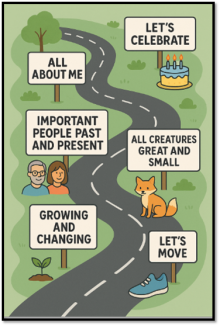 As EHPS does not have a nursery or pre-school attached, our children arrive from a wide range of early years settings. This means we must act swiftly to understand their starting points. We complete rigorous baseline assessments as soon as children start school to ensure teaching and provision are adapted quickly and effectively to meet each child’s needs. This careful assessment allows us to provide the right support, challenge and nurture from the very beginning of their EHPS journey.
At EHPS, we follow the seven areas of learning as set out in the EYFS Development Matters (2021), ensuring a balance between child-led exploration and high-quality direct teaching. We know that learning begins with relationships; our practitioners prioritise knowing our children deeply, supporting wellbeing, confidence and belonging from day one.
Our curriculum entwines our school values (Be Kind, Work Hard, Believe) and our rules (Be Ready, Be Respectful, Be Safe), creating a nurturing environment where children feel valued, confident and ready to learn.
Implementation
Our EYFS curriculum is carefully sequenced to ensure progression in knowledge, skills, and understanding across all seven areas of learning. It is enriched by our local community, outdoor learning and our ‘70 Things To Do Before You Leave EHPS’ enrichment promise.
Teaching is delivered through a balance of adult-led and child-initiated learning. Skilled adults guide play, extend language and model high-quality communication through Voice 21 Oracy principles. Each term includes a focused provocation that connects learning to children’s interests and their growing understanding of the world.
At EHPS we intentionally embed Blank’s Language Levels across continuous provision to ensure every child receives high-quality oral language questioning. Adults move children through Levels 1–4 to develop vocabulary, reasoning, and inference. This approach is evidence-informed, recommended by NHS Speech & Language Services, and supports both SEND and EAL learners.
It ensures strong foundations in the EYFS Communication & Language ELGs and secures readiness for reading comprehension and writing.
We teach systematic synthetic phonics through Sounds-Write, handwriting and transcriptional skills through Kinetic Letters and compositional writing through Talk for Writing. Mathematics is taught using the Teaching for Mastery approach, enabling children to develop strong number sense and ensure they have the strong foundations required for later mathematical work.
Our bespoke music curriculum, Real PE, and a 12-week Forest School programme provide creative, physical and outdoor opportunities to embed skills and build character.
Practitioners embed the Characteristics of Effective Learning - playing and exploring, active learning and creating and thinking critically - across all provision. The seven features of effective practice (pedagogy, curriculum, assessment, self-regulation, communication, enabling environments and parental partnership) are central to our delivery.
Everything we do in EYFS is purposeful and designed to ensure that children meet the Early Learning Goals (ELG) and are well prepared for the demands of the Year 1 curriculum.
Impact
We measure the impact of our curriculum from the moment children join EHPS. Baseline assessments - including the Reception Baseline, NPAT Baseline and our own internal assessments - identify individual needs and next steps, enabling us to provide early intervention and targeted support particularly for children with SEND, EAL or those who are disadvantaged.
Impact is monitored through ongoing formative assessment and high-quality practitioner observations which give us a rich picture of each child’s progress and development. While achieving a Good Level of Development (GLD) at the end of Reception is an important indicator, it is not the only measure. We also consider children’s ability to access the next stage of learning confidently, their independence and their engagement in everyday routines and interactions.
The success of our provision is seen in children who are articulate, resilient, kind and ready for Year 1. Where children have not yet reached GLD, we continue targeted provision and ensure collaboration between EYFS and KS1 teams so that transition is seamless and learning builds securely.
We prioritise strong foundations in reading, writing, oracy and mathematics because these are essential for accessing the wider curriculum and for lifelong learning. From the very start of Reception, children are taught through whole-school, carefully researched approaches:
-
Sounds‑Write,
-
Talk for Reading,
-
Talk for Writing,
-
Kinetic Letters and
-
Maths Mastery
all underpinned by the Characteristics of Effective Learning.
These age-appropriate pedagogies begin in the Early Years and run throughout our school, ensuring a seamless progression. Highly skilled teachers and teaching assistants provide carefully timed, targeted support and interventions (including WellComm and NELI) so children can keep up, not catch up.
Reading
Early Reading is a crucial skill and much more than decoding. We teach systematic, rigorous phonics using Sounds‑Write while developing comprehension and dialogic discussion through Talk for Reading. Every day, children hear multiple stories, poems and nursery rhymes and engage with class novels, picture books and non‑fiction texts to build knowledge, vocabulary and a love of literature.
We use the Scarborough Reading Rope as a shared model to weave together word recognition and language comprehension, enabling children to become fluent, motivated readers.
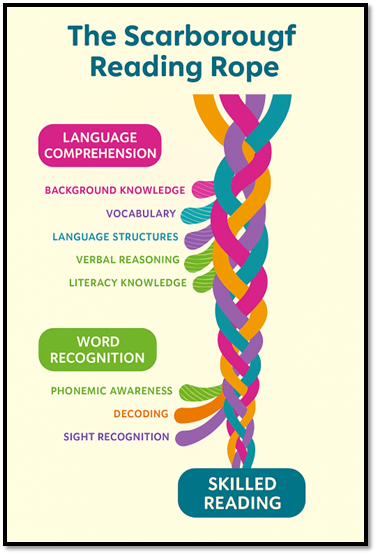
Language Comprehension Strands
-
Background Knowledge - Knowing about the world helps children understand what they read.
-
Vocabulary - Learning lots of words makes reading easier and more fun.
-
Language Structures – Understanding how sentences work helps children make sense of stories.
-
Verbal Reasoning - Thinking about what words and sentences mean beyond the literal.
-
Literacy Knowledge - Knowing how books and stories work (e.g., reading left to right, story patterns).
Word Recognition Strands
-
Phonemic Awareness - Hearing and playing with sounds in words.
-
Decoding - Using phonics to sound out words.
-
Sight Recognition - Quickly recognising words without sounding them out.
When these strands are woven together, children become skilled readers who can read fluently, with automaticity and understand what they read.
Reading for Pleasure includes:
-
Carefully resourced book areas in classrooms
-
Books embedded across all areas of continuous provision
-
Story play and daily storytelling routines
-
Weekly visits to the school library and an annual visit to our local library
-
Participation in RED (Read Every Day) October
-
Access to our EHPS 100 Reads
-
Sharing children’s and teachers’ favourite books
Writing
We teach writing composition through Talk for Writing, immersing children in rich language, model texts and purposeful composition. Children internalise patterns of language, sentence structures and text features through imitation, innovation and independent application.
Handwriting is taught with Kinetic Letters, focusing on posture, pencil grip and accurate letter formation so that fluency and stamina can develop as ideas grow. We have a progressive plan for the development of transcriptional writing inorder for these skills to eventually liberate the composition.

Oracy
Oracy underpins learning across the curriculum. Through our partnership with Voice 21, children learn to articulate ideas clearly, listen actively and engage in purposeful, respectful dialogue. We sequence and map key vocabulary for early language acquisition and provide targeted support (e.g. WellComm, NELI) where needed. These practices build confident communicators whose speaking and listening skills strengthen reading comprehension and writing fluency.
Mathematics
Mathematics is taught through a Maths Mastery approach that cultivates deep conceptual understanding, mathematical language, reasoning and problem‑solving. Carefully sequenced small steps, intelligent practice, manipulatives and visual representations help children make connections and secure number sense. This ensures strong early foundations for later mathematical learning.
Why Strong Foundations Matter
By aligning Early Years’ provision with our whole‑school approaches: Sounds‑Write, Talk for Reading, Talk for Writing, Kinetic Letters and Maths Mastery and by embedding the Characteristics of Effective Learning, we ensure every child has the knowledge, skills and dispositions to access the wider curriculum and thrive in learning and in life beyond the reception years which aligns closely with achieving our mission statement of: Being prepared for the next stage of their educational journey.
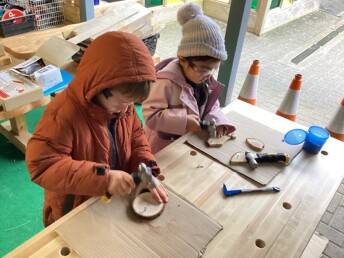
At East Hunsbury Primary, we are proud to include woodwork as a unique and valuable part of our Early Years curriculum. We believe that hands-on experiences like woodwork and physical activity are essential for developing not only practical skills but also confidence, creativity and resilience.
Why Woodwork Matters
Woodwork is far more than creating a finished product - it is about process-based learning that empowers children to shape their world. Through woodwork, children learn to plan, problem-solve and persevere when things don’t go as expected. These experiences teach resilience and a “can-do” attitude that will serve them throughout life.
Key Learning and Development Outcomes
Woodwork touches on all major areas of development through hands-on experience:
-
Physical Development
-
Fine Motor Skills - Handling nails, screws and tools improves finger dexterity.
-
Gross Motor Skills - Sawing and hammering strengthen upper body muscles and core stability.
-
Hand-Eye Coordination - Using tools safely and accurately requires focus and precision.
Cognitive and STEM Skills
-
Mathematical Thinking - Measuring, counting and understanding shapes in real contexts.
-
Scientific Inquiry - Exploring material properties and forces like friction and leverage.
-
Problem-Solving - Overcoming challenges such as split wood or loose joints fosters creativity and critical thinking.
Personal, Social and Emotional Development
-
Resilience and Confidence - Completing a project or mastering a tool builds self-belief.
-
Risk Management - Learning to use real tools safely teaches responsibility and decision-making.
-
Collaboration - Working on shared projects encourages teamwork and communication.
Physical Activity and Resilience
Alongside woodwork, we prioritise physical activity every day. Our outdoor spaces and Forest School sessions provide opportunities for climbing, balancing, running and exploring nature. These activities develop strength, coordination and stamina while teaching children to take safe risks, overcome challenges and build resilience. Physical activity is woven into our curriculum because we know that active, confident children are ready to learn.
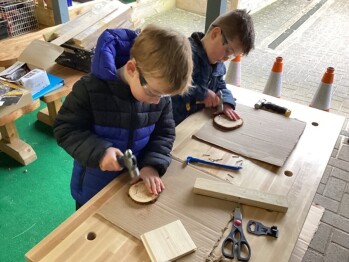
At EHPS, woodwork and physical activity are not extras - they are integral to our vision of an inclusive, aspirational curriculum that nurtures the whole child. Through these experiences, children learn perseverance, problem-solving and independence, laying strong foundations for lifelong learning.