Mathematics
Maths at EHPS is aspirational, engaging and inclusive and ensures pupils become confident mathematicians with a secure, flexible, deep and long term understanding of mathematical concepts and ideas.
Intent
It is our intention to provide an interconnected, inclusive maths curriculum which enables our pupils to become confident and competent mathematicians with a secure and flexible understanding of maths. Our curriculum ensures pupils’ carefully build and deepen their understanding of mathematical concepts; develop their mathematical fluency; challenge their mathematical thinking and experience mathematical success. It is our intention that children leave East Hunsbury as confident mathematicians with the skills, knowledge and positive maths mindset needed for their future success in education, the workplace or their everyday life. We believe that every child can succeed and achieve in maths.
Our maths curriculum is aspirational, enabling and inclusive and ensures children will:
-
Develop a deep and connected understanding of mathematical concepts
-
Demonstrate fluency in mathematical facts and procedures
-
Reason logically and be able to explain and communicate their mathematical ideas
-
Be confident, resilient and competent mathematicians who experience success
-
Apply maths flexibly across the curriculum and to real-life contexts
-
Understand that mathematics is an important life skill which is fundamental to many careers
Throughout our maths curriculum, learning is purposeful and ensures challenge for all. We intend for our maths curriculum to be guided by six principles:
-
Purpose – knowledge is sequenced effectively to ensure a clear progression of knowledge which builds on prior knowledge and is informed by assessment.
-
Connectiveness – the teaching for mastery approach exposes the relationship between mathematical concepts, processes and representations as well as between mathematics and the real world.
-
Aspirational – pupils see themselves as mathematicians. They understand the role that maths plays in their everyday life and in possible future careers.
-
Inclusivity – learning is inclusive and challenging for all; learning experiences are adapted to ensure all individual needs are met.
-
Confidence – pupils are confident mathematicians who demonstrate resilience and determination.
-
Communication – pupils accurately communicate and explain their mathematical ideas.
Implementation
At East Hunsbury, we teach an ambitious, well-sequenced, inclusive maths curriculum which promotes a can-do attitude for all pupils. Maths is taught daily through quality first teaching, using the teaching 1 for mastery approach. Alongside this, we teach separate fluency sessions which prioritise the teaching and learning of number sense – supporting pupils to decompose and recombine numbers; develop an understanding of the relationship between them and become secure in number facts.
We teach mathematics using a teaching for mastery approach and ensure the use of high-quality teaching resources to support the effective teaching and learning of mathematics. The content of our maths curriculum is informed by the National Curriculum and we use resources provided by the NCETM and Oak National Academy to support with planning and ensure our curriculum builds progressively. A coherent curriculum with purposeful small, carefully sequenced steps allows our pupils to develop a secure and thorough understanding of mathematical concepts.
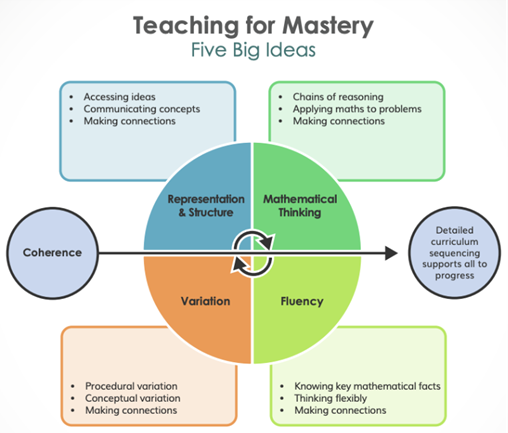
Our maths curriculum is underpinned by the NCETM’s Five Big Ideas in Teaching for Mastery:
-
Coherence – small, connected steps are mapped out to ensure a coherent learning journey that enables pupil to see connections between different mathematical ideas.
-
Representation and Structure – carefully chosen representations are used to support pupils to ‘see’ the mathematics and develop a deep understanding of mathematical structures and connections.
-
Mathematical Thinking - pupils actively engage in mathematical thinking using precise language to communicate and discuss their ideas; pupils look for patterns and relationships, make connections, conjecture, reason and generalise.
-
Fluency – pupils are supported to accurately and efficiently recall key number facts and procedures and have the flexibility to move between different mathematical contexts, explaining ideas and choosing appropriate methods and strategies.
-
Variation – purposeful opportunities are provided to draw pupils’ close attention to key features of mathematical concepts or structures, enabling pupils to deepen their understanding of structures and concepts and making learning accessible to all.
Our curriculum is designed to provide challenge for all. Challenge is achieved through going deeper within a concept and providing open-ended problems, encouraging mathematical thinking, providing opportunities for independent exploration of a context or structure and through oracy-rich classrooms where mathematics is discussed and ideas are communicated clearly to others.
Impact
The impact of the maths curriculum at East Hunsbury Primary School is evaluated through a range of approaches, demonstrating that pupils will leave with a secure, deep and adaptable understanding of the subject. Our pupils will be confident mathematicians who engage fully in lessons, demonstrate a positive attitude towards mathematics and understand the relevance and importance of their learning both within and beyond the classroom. Pupils acquire a strong sense of number and demonstrate mathematical fluency whilst showing the confidence to challenge their own thinking and articulate their ideas effectively and with precision.
All our pupils will experience success in mathematics and achieve well – pupils will meet age-related expectations unless there are significant barriers to their learning. Our maths curriculum equips pupils with the mathematical knowledge and skills they need for their future success in education, the workplace or their everyday life and enable them to approach a wide range of real-life contexts with confidence and independence.
Maths is taught daily in all year groups. Lessons are timetabled to ensure children receive at least 50-minute maths lessons in Key Stage 1 and 60-minute maths lessons in Key Stage 2. Within the Early Years provision, maths is taught daily in short whole class sessions with learning consolidated through carefully planned learning experiences within the provision. Fluency is a key component of our maths curriculum with discrete fluency sessions taught at least three times a week within each year group.
The maths units taught throughout our curriculum are in line with the requirements of the National Curriculum and include Number and Place Value, Number facts, Addition and Subtraction, Multiplication and Division, Fractions, Measurement, Geometry, Statistics and Algebra. Knowledge builds progressively throughout the curriculum from EYFS to Year 6 with mathematical content being revisited and retrieved frequently to support pupils to build a deep conceptual understanding of mathematical concepts and the connections between them.
We ensure that children understand and recognise links between maths, the wider curriculum and real-life contexts through carefully planned links across subjects, for example the use of measurements and statistics in science; graphs and map coordinates in geography; time, dates and chronology in history; position and direction in PE; and shapes and geometry in art.
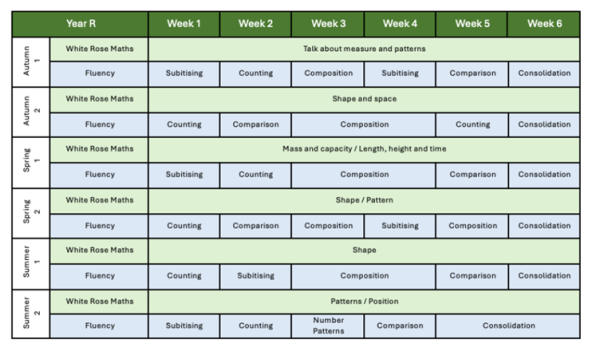
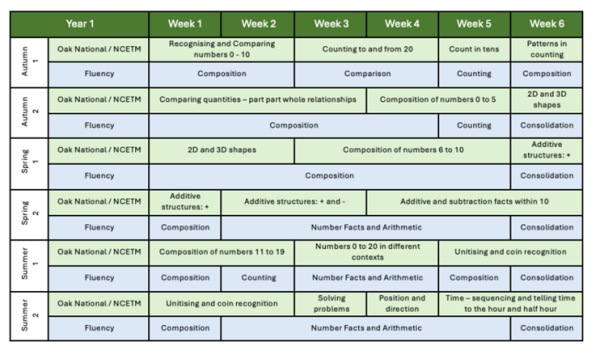
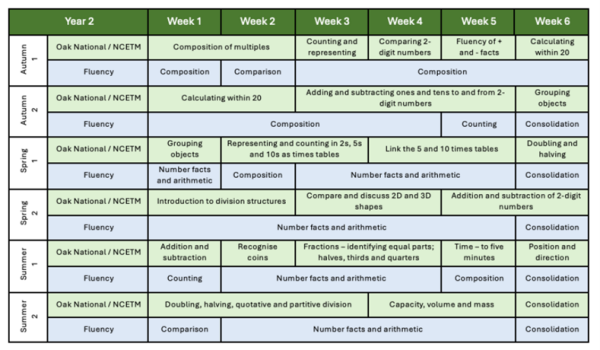
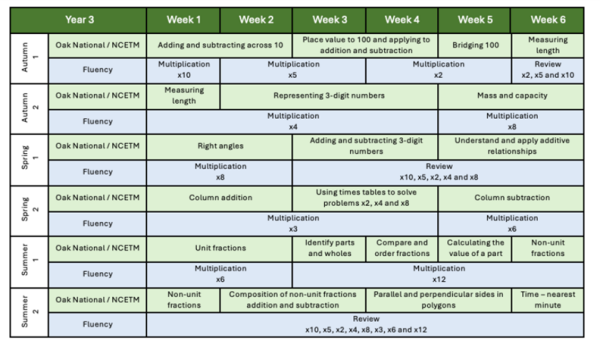
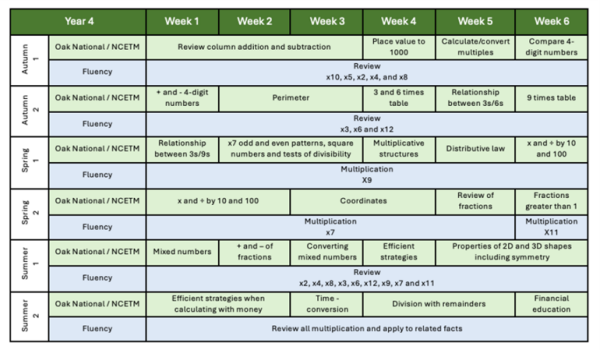
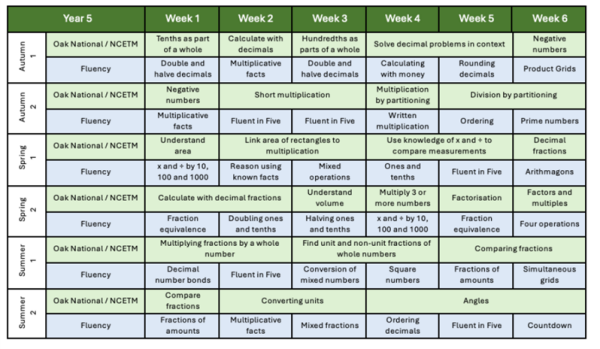
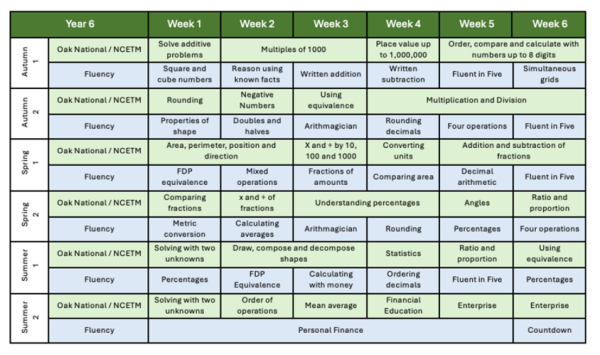
Maths is taught daily across the school and is planned for using high-quality resources which ensure a coherent learning journey from the Early Years to the end of Key Stage 2. Learning is broken down into small, sequenced steps and it is this which enable pupils to build their understanding of mathematical concepts and expose the relationships between them.
Our maths curriculum uses a ‘Concrete, Pictorial, Abstract’ approach whereby pupils use physical and visual aids to facilitate their understanding of an abstract concept. We begin by using manipulatives to support pupils to ‘see’ the structure of the maths before using pictorial representations of concrete objects to further expose the structure and to bridge the gap between the concrete and abstract representations. The CPA approach provides the scaffolding required to ensure progress and success for all our pupils.
Oracy is an important feature of our maths curriculum. Mathematical talk enables our pupils to express their ideas and articulate their thinking whilst also enabling pupils to develop their sense-making. Questions and tasks are planned for which provide opportunities for mathematical talk. Furthermore, stem sentences are incorporated into lessons to promote oracy in maths. These structured sentences provide a scaffold for all pupils to explain mathematical concepts or verbalise their ideas using accurate and precise mathematical language.
Fluency in mathematics begins in the Early Years, through the Mastering Number programme, and continues into Key Stage One and beyond. Separate fluency sessions are taught at least three times a week throughout Key Stage One and Key Stage Two with the aim being to develop pupils’ sense of number, including their understanding of the composition of numbers and the relationship between them. Fluency sessions also develop pupils’ automaticity of additive and subtractive number facts alongside multiplicative facts in Key Stage Two. Fluency in calculations is another integral part of our maths curriculum and supports pupils to apply known facts flexibly, accurately and efficiently. Conceptual and procedural variation within maths lessons further supports this. By providing opportunities within our maths curriculum for pupils to become fluent mathematicians, it increases their confidence, reduces anxiety and empowers them to calculate accurately, choose efficient strategies and apply their understanding to a range of mathematical contexts and problems with increasing success.
We ensure the following key elements of effective teaching are included within our maths curriculum.