Personal Social Citizenship and Health
Intent
At East Hunsbury Primary School, our brilliant PSHE and C curriculum is aspirational, enabling and inclusive and sits at the heart of everything we do. We value the importance of developing our children as individuals as well as global, healthy citizens.
Our highly effective teaching in PSHE and C is developed through adopting a consistent approach and the follow up and follow through of our curriculum leaders, who monitor delivery and train and develop our teachers. Sessions are taught using a combination of quality circle time, class community time, assemblies, discussion and response tasks.
PSHE and C content is evident in our classrooms daily; it is not constrained to timetabled sessions. Links within in other subjects are drawn to allow children to develop a more comprehensive understanding of health, wellbeing, relationships and how to be good citizens of the wider world.
The overarching aims of our curriculum are that children will:
-
Develop the knowledge, skills and attributes that they need to navigate their lives now and, in the future, becoming brilliant global citizens.
-
Understand how to keep healthy and safe, including how to have purposeful and reciprocal relationships.
-
Understand the importance of valuing similarities and differences and how to recognise and manage their emotions.
Underpinning all learning and woven throughout will be the British Values of:
-
Democracy
-
Rule of Law
-
Individual Liberty
-
Mutual Respect and
-
Tolerance
And the protected characteristics:
-
Age
-
Disability
-
Gender
-
Sexuality
-
Relationship Status
-
Race
-
Religion or world view
We took the strategic decision to develop our own PSHE and C curriculum tailored and developed for the precise needs of our pupils. Our curriculum is grounded in research, informed by our teachers, pupils and parents and follows a comprehensive and progressive coverage of key concepts. Through the implementation of this curriculum, it is intended that children are taught how to navigate their changing world and supported to develop positive relationships with themselves and others. They will be given the tools to recognise and manage their emotions and the mental fitness to equip them with tools for life.
It is the intent of our curriculum that by the end of Key Stage One pupils will:
-
Have a positive relationship with themselves, peers and adults within the school
-
Demonstrate a healthy attitude towards school and learning
-
Begin to demonstrate the British Values of democracy, tolerance, mutual respect, the rule of law and liberty
-
Respect the Protected Characteristics of; age, disability, gender, sexual orientation, relationship status, race, pregnancy and maternity
-
Know how to stay safe in their physical and digital worlds
-
Begin to have an awareness of their emotions and how to manage them
-
Begin to have an awareness of their own mental health and well-being
-
Begin to develop an inclusive attitude that challenge discrimination in all forms
-
Understand the changes that happen to themselves and other animals and have taken part in age-appropriate RSE
It is the intent of our curriculum that by the end of Key Stage Two pupils will:
-
Have a positive relationship with themselves and the wider school community
-
Have developed a positive body image
-
Demonstrate the British Values of democracy, tolerance, mutual respect, the rule of law and liberty
-
Respect the Protected Characteristics of age, disability, gender, sexual orientation, relationship status, race, pregnancy and maternity
-
Demonstrate a healthy attitude towards learning and its place in their future
-
Understand what constitutes as a healthy relationship and how to seek help if they find themselves in an unhealthy situation
-
Have respect for themselves and others
-
Know how to stay safe in their digital and physical world
-
Have an inclusive attitude that actively challenges discrimination in all its forms
-
Have an awareness and understanding of their own mental health and wellbeing and know where to turn for help should they need it
-
Understand change and have strategies to draw on when they need to approach changes in their lives
-
Have an awareness of their emotions and how to manage them
Understand the physical aspects involved with RSE at a developmentally appropriate level.
Implementation
Our PSHE + C programme is built around our school values and rules of be kind, work hard, believe and ready, respectful and safe. Each unit encompasses health and wellbeing, British Values, protected characteristics and emotional literacy. The curriculum is interleaved with opportunities to learn simple mindfulness tools and techniques.
As our rules and values underpin our brilliant curriculum, PSHE and C is a part of our daily lives at East Hunsbury Primary School. It is evident in all we are and all we do. Discrete teaching takes place in weekly assemblies, PSHE and C lessons and fortnightly Classroom Community time.
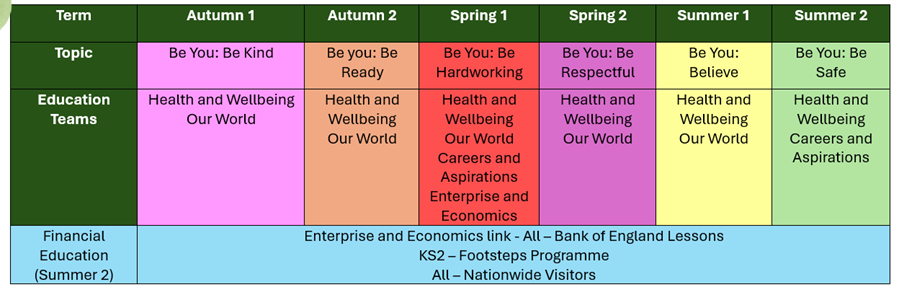
Teaching of PSHE+C is evident in many of our curriculum areas and teams, we work very closely with our Health and Wellbeing and Careers and Aspirations curriculum teams.
Impact
Due to the personal nature of the subject, the impact of our PSHE and C curriculum is assessed in a distinctive way. Progress and attainment will manifest itself through:
-
The daily life at EHPS and how children interact with adults, peers and view themselves
-
Pupil’s manners and positive learning behaviours
-
Playground: happy play and lunch times
-
Displays and assemblies promoting the importance of PSHE and C
-
In the conversations that children hold and the values which they display
-
Work and the reflections that children complete
The impact will also be monitored through pupil voice, parent voice, teacher voice, the monitoring of written work and learning walks.
Formal summative assessment takes place termly, where teachers assess the children against given questions for each learning area. This data is then recorded Insight annually at the end of the summer term.
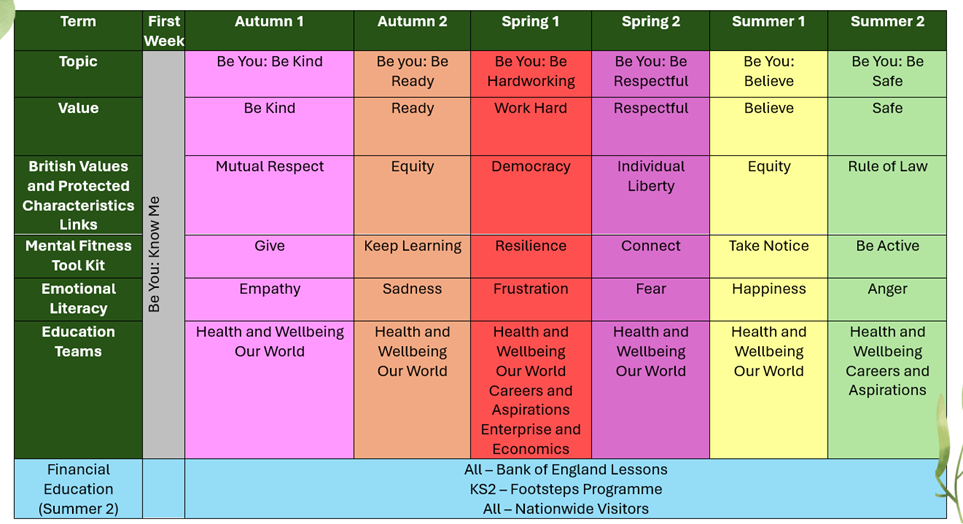
More information about the progression of knowledge and skills through each year group can be found in the PSHE+C progression document. This can be found on our website under Key Information: Our Curriculum: Personal, Social, Health Education and Citizenship.
In PSHE and C, British Values and Protected Characteristics are taught with our termly units. The details of this can be seen in the table below.
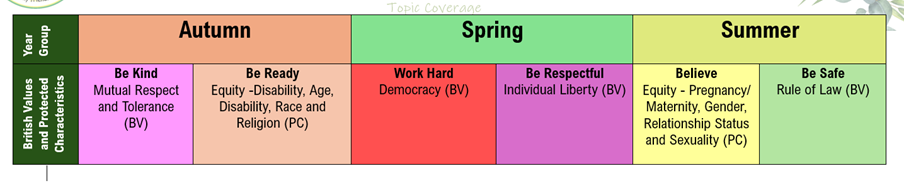
British Values
Children learn about the British Values through assemblies and classroom discussions, and they are threaded throughout the PSHE and C curriculum. Some examples of this are:
Democracy: Children are encouraged to share their views, interests and options and vote for their preferences where appropriate.
Rule of Law: Children are encouraged to follow and understand the school rules of “ready, respectful and safe” comparing these to the laws of our country.
Individual Liberty: Children are encouraged to reflect up on the freedoms they have such as Freedom of speech, freedom to choose (food, activities etc,) freedom to spend time with their friends and compare these to other people in the world.
Mutual Respect: Children are encouraged to express different ways in which they can show respect towards our school community and beyond.
Tolerance: Children are actively taught how to make friends and build relationships with all people.
Protected Characteristics
The protected characteristics are actively promoted throughout our curriculum to ensure that pupils have an age-appropriate knowledge and understanding of the nine protected characteristics. Our curriculum, including PSHE and C, ensures that, as a school, we:
-
Eliminate discrimination, harassment, victimisation and any other conduct that is prohibited by or under the Equality Act 2010.
-
Provide equality for all.
-
Foster good relations between persons.
We have worked closely with our Health and Wellbeing Team to develop our very own “Mental Fitness Tool Kit,” based on the NHS 5 ways to wellbeing. This is a physical tool kit that they add to and keep for their school career and beyond. Each year they learn new skills and techniques to help them develop their mental fitness within the areas of:

With the support of the Enterprise and Economics Team we provide financial education for all including using lessons from the Bank of England and visitors from Nationwide Bank.
Alongside the Carers and Aspirations team we hold careers events and regularly invite inspirational speakers to come into our assemblies, such as British Gymnastics, to inspire our pupils in their future endeavours.
In 2025, our hard work in promoting kindness within our school and beyond was recognised by the national charity “52lives,” they voted us to be the national “school of kindness.” As a result of this, a group of our dedicated Kindness Ambassadors travelled to the House of Commons to lead a discussion around kindness with Members of Parliament, including the Leader of the House. We are very proud of this achievement and this wonderful group of children.