Religious Education and Worldviews
Intent
At East Hunsbury Primary School, Religious Education and Worldviews plays a key role in developing our children’s knowledge and understanding of the diversity of worldviews and belief systems. Our curriculum is aspirational, enabling and inclusive and it is our intention that it equips children with the skills to question, discuss and explore the cultures and beliefs of society.
We believe it is important to broaden children’s understanding of cultures and beliefs so we intend for our curriculum to prepare children to meet those who have different cultures and beliefs and to understand and develop acceptance and tolerance for those whose beliefs are different to theirs. At East Hunsbury Primary School, we consistently develop children’s spiritual, moral, cultural and social education, helping them to have a greater understanding of their place in the world.
At East Hunsbury Primary School, it is our intention that our Religious Education and Worldviews curriculum will:
-
Expand children’s knowledge and understanding of the six main religions.
-
Enable children to develop religious literacy by exploring and understanding a variety of religious and non-religious worldviews.
-
Teach children to reflect and discuss diversity and values.
-
Develop in every child a rich, deep knowledge and understanding of religious and non-religious worldviews and practices, providing a secure foundation that will enable them to succeed as they move to their next stage of education.
-
Promote tolerance, understanding and dispel prejudice to enable our children to be able to live, work and socialise in the wider community.
Our RE and Worldviews Curriculum aims to ensure that all children acquire and develop the knowledge and understanding of the diversity of world views and belief systems alongside an understanding of the influence these beliefs, values and traditions can have on individuals, communities and society. We intend for our children to develop respect for others who hold different views and beliefs from their own and to acquire the skills to question, discuss and evaluate information and form their own opinions.
For more information, speak to the RE and Worldviews lead who will be able to direct you to the NPAT Religious Education Narrative.
Info on Parental Withdrawal in RE and World Views
In 1944, the curriculum for RE was introduced as "Religious Instruction," which carried connotations of introducing pupils to the Christian faith. However, RE has evolved significantly since then to become a more inclusive subject, which explores various religious and non-religious worldviews with the aim of helping pupils understand the world they live in. In the UK, parents still have the right to withdraw their children from RE as do pupils over the age of 18. If you feel you would like to withdraw your child from RE please contact your class teacher who can arrange a meeting with the RE Lead to discuss your concerns.
Implementation Overview
At East Hunsbury Primary School, we implement our RE and Worldviews teaching through an ambitious, high-quality RE and Worldviews curriculum which is carefully constructed to ensure that children develop a solid understanding of the diversity of worldviews and belief systems and an understanding of the effects that beliefs, values and traditions can have on individuals but also communities. Substantive, disciplinary and personal knowledge is sequenced in small steps which build upon prior knowledge and ensure children develop their understanding over time.
Religious Educations and Worldviews is taught through four high-dividend concepts which are woven through the curriculum and form the ‘big ideas’ through which all RE and Worldviews are taught: Belief, Community, Festivals and Worship. Explicit links are made between these concepts. Our curriculum also incorporates explicit horizontal links across a year group; vertical links where knowledge and understanding are built upon from previous units and diagonal links where meaningful links are made across the wider curriculum.
We ensure that, throughout our RE and Worldviews curriculum, children build their knowledge of both religious and non-religious worldviews and develop respect, understanding and empathy for others.
Impact
By the end of Key Stage 2, our children will demonstrate sound knowledge of the diversity of worldviews and beliefs. Our children develop respect and appreciation for others who hold different beliefs and views from their own and question, discuss and evaluate information to form their own opinions. Our curriculum intent will be fulfilled.
The impact of our curriculum will be assessed through a multi–faceted approach including:
-
skilful questioning lesson by lesson,
-
high quality discussion with teachers during lessons, addressing misconceptions,
-
weekly retrieval practices,
-
lesson quizzes,
-
appropriate writing outcomes and
-
end of unit summative tasks.
Evidence of learning is recorded within Religious Education and Worldviews books and teachers assess against the RE and Worldviews learning outcomes for each lesson and/or unit. Leaders will monitor the quality and impact of the RE and Worldviews curriculum through book-looks, pupil voice and lesson visits and assess which pupils know more and remember more. Pupil attainment in RE and Worldviews is recorded on Insight annually at the end of the summer term.
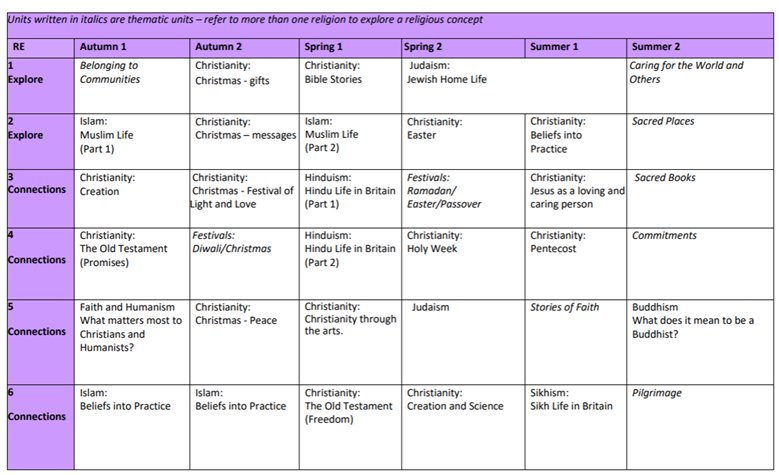
RE is taught weekly in all year groups for an hour a week throughout Key Stage 1 and Key Stage 2. Within the Early Years, RE is taught through carefully planned learning opportunities within the setting. The units taught are in line with the National Curriculum and the Sacre and have been carefully planned to ensure there is a sequenced progression which builds understanding and knowledge. Within Key Stage 1, children learn about Christianity, Judaism and Islam. The knowledge of these religions is then built upon throughout Key Stage 2 where they learn about each belief in more detail but also begin to develop their understanding of Hinduism, Buddhism and Sikhism.